A closer look at five dimensions of my experience relevant to Augustine Institute’s Sr. Director of Sales role: mission alignment, sales-team development, go-to-market strategy, sales intelligence, and communication through music.
Mark KotcherSales leadership · Commercial transformation
Five dimensions
Experience relevant to the role.
Each dimension connects a responsibility in the position to the way I lead. Where original work is available, it is linked directly.
Mission alignment
Faith, formation & servant leadership
In the Church, a sales conversation begins with the dignity of the person and the pastoral need being served. Parish planning, Catholic-school research, graduate theology, ACTS, and sacred music show how I listen within Catholic communities and translate mission into practical work.
High-performing teams need clarity about the customer, defined roles, an operating cadence, practical coaching, and accountability that helps people improve. The work here shows how I move from customer insight to organization design, enablement, and field execution.
My commercial work spans pricing, P&L leadership, merchandising, key accounts, new channels, and product launches—with the emphasis on turning a growth strategy into coordinated choices across Sales, Product, Marketing, and Operations.
Data matters when it improves a decision. My approach is to define the question, make assumptions transparent, connect measures to economics, and translate the answer into action a team can understand and carry forward.
Songwriting, recording, live performance, Catholic worship, and original composition reveal another dimension of leadership: prepare deeply, listen closely, communicate with diverse audiences, and help a group create something larger than any one part.
Serving parishes and schools requires more than product knowledge. Across parish planning, Catholic education, and theological study, the same conviction appears: begin with people’s lived experience, invite participation, and connect the Church’s mission to a practical plan.
“Young people must take the lead” was the central conclusion of the parish visioning work. The theology papers develop the same idea more fully: durable formation depends on authentic relationships, meaningful experiences, and a voice in one’s own path.
Documented through work from 2013–2019
Graduate theology · 2019
Pressing issues in evangelizing young people
This authored paper examined the cultural, family, catechetical, and institutional barriers affecting youth evangelization. Its central concern was not to blame young people, but to recognize how adult institutions can leave them without the relationships or formation needed to understand and own their faith.
The paper argued for a response rooted in honest engagement, stronger parental and ministerial support, clear Catholic teaching, and a more personal relationship with Christ and the Church community.
Question exploredHow can the Church form young people in a culture that often leaves them to construct meaning alone?
Program concept · 2019
A bold vision for new college students
This authored capstone concept focused on the vulnerable transition between high school and college. It proposed a sixteen-week, student-led formation experience built around mentoring, Catholic teaching, sacramental life, pilgrimage, service, retreat, and an individual formation plan.
The proposal also defined measures of success: pre- and post-program learning, participation, student testimony, college retention and vocation data, plus structured reviews with stakeholders. The concept connects pastoral imagination with disciplined program design.
Mark authored the planning presentation that synthesized a day-long session with approximately 130 parishioners and two follow-up surveys. It organized findings across worship, Christian service, formation, and administration, then translated them into specific action areas.
The clearest priority was youth and young-adult engagement. Recommendations included a dedicated task force, direct listening with teens and twenty-somethings, stronger parish leadership representation, and a plan spanning worship, music, service, communication, and social connection.
For the Advancement Committee, Mark designed and completed the research, analysis, presentation, and recommendations examining how students and faculty experienced the school. More than 600 students and nearly 70 faculty participated in quantitative and qualitative research covering school choice, belonging, academics, activities, empowerment, and the Catholic environment.
The work found that relationships and direct experience mattered deeply. Shadowing helped prospective students understand the atmosphere; current students emphasized belonging, independence, friendship, and a “home away from home.” The recommended brand platform connected those experiences to the formation of educated, caring, empowered young women.
Research and dialogue surface what a community actually experiences.
Formation is relational.
Belonging and trusted mentors create the conditions for growth.
Participation must be real.
Young people help shape the work rather than simply receive it.
Vision needs measures.
Clear outcomes make learning and accountability possible.
Sources reviewed: the 2015 Mary Mother of the Church strategic-planning presentation, the 2013 Nerinx Hall brand-research presentation, and two authored CAT 720 papers dated October and December 2019. Historical statistics and quotations remain attributed to their original sources within those documents; they are not presented here as current data.
Sales leadership & team development
Design the sales system. Equip people to lead it.
A high-performing sales ecosystem connects customer insight, clear roles, disciplined operating routines, coaching, enablement, and accountability. The work moves from listening to the customer and designing the organization to building the playbooks, communications, and practical tools a distributed team needs to execute.
Sell consultativelyBegin with the customer’s need
Design the systemRoles, coverage & operating cadence
Coach for executionPlaybooks, training & accountability
Executive education applied · December 2025
Turning influence into a teachable sales discipline
Drawing on Wharton executive education, I translated an influence framework into a practical method for the sales team: understand the customer’s world, frame the real problem, connect the idea to a solution, support it with credibility, human stakes, and clear economics, then make one specific ask.
The training was built for the realities of selling to independent business owners—not as pressure or manipulation, but as a repeatable way to help customers make better decisions. The session moved immediately from instruction to practice through a live 120-second sales challenge, giving the team 30 seconds to prepare and two minutes to persuade.
Leadership approachLearn it. Translate it. Teach it. Practice it.
Executive learning converted into a customer-centered coaching system for the team.
Customer strategy · January 2024
Delighting Retail Partners
The field leadership team assembled direct input from Regional Directors, Area Business Consultants, and Regional Perishable Partners. The work began with more than 30 field perspectives and a full-day leadership session focused on how the company could serve independent retail partners more effectively.
The recommendations extended beyond selling. They addressed trust, response time, communication, product availability, pricing, merchandising, execution, technology, and the field team’s own priorities. The central idea was consultative: a credible sales strategy had to begin with the customer’s experience of the whole company.
field perspectives, followed by a full-day leadership working session
Field execution playbook · 2024
Store in a Box
This is the operating playbook behind a repeatable store-reset program. It turns the concept into detailed action: pre-reset preparation, equipment and signage, product flow, fresh-meat and produce standards, image-wall construction, points of interruption, incremental merchandising, and post-reset follow-up.
The playbook shows the less visible side of sales leadership: turning product knowledge into a teachable, executable, and sustainable field standard. It specifies 30-, 60-, and 90-day coaching and follow-up rather than treating the sale as the finish line.
Execution modelFrom commitment through 90-day follow-up
A common operating standard for a distributed network
Sales enablement · Food Show
E-commerce sell-in
This one-page Food Show piece translated digital-channel performance into a concise retailer proposition. It combined documented sales-lift and basket figures with shopper behavior, then gave the audience a direct next step.
It is included as a practical example of turning a complex strategy into communication that can be understood and acted on quickly.
Communication taskMake the value clear in one page
Network sales communication · 2024
Marketing program webinar
This webinar introduced independent retail partners to a customer-engagement program and the broader 2024 marketing offer. It explained the business purpose, functionality, funding model, participation requirements, implementation timeline, print changes, and digital-media support.
The material demonstrates structured sell-in across a distributed network: define the opportunity, make the economics understandable, establish consistent messaging, state the operating requirements, and give partners a clear path to participation.
Strategy, economics, requirements, and launch plan in one conversation
Organization design · July 2024
Field Sales & Operations charter
This work translated the customer strategy into organizational choices. It examined field coverage, store conditions, struggling locations, fresh expertise, duplicated sales activity, role clarity, support functions, incentives, and the balance between sales and operations.
The proposed structure included dedicated turnaround support, stronger specialist capability, centralized sales enablement, clearer responsibilities, redesigned incentives, and more time with customers. The deck contains both the strategic proposal and the operating detail needed to define leadership roles, priorities, coverage, and accountability.
Design questionHow should the field team be structured to make stores successful?
Interactive proof · Historical prototype
Wholesale ordering experience
When internal IT resources were not available—and an outside build would have been too expensive and taken too long—I built this working prototype myself in one week while on vacation. It translates commercial strategy into a customer-facing product experience: searchable assortment, product filters, item detail, customer-specific pricing logic, barcode lookup, cart building, order totals, and CSV export.
The point was not simply to make a website. It was to demonstrate the intended experience quickly enough for people to see, test, and improve the idea rather than waiting for a traditional development cycle. The prototype is not connected to a live ordering system, and its product and pricing information should be treated as historical.
From strategy to executionBuilt personally, in one week.
A working customer experience created without an internal IT allocation or outside development firm.
The leadership pattern
Sell consultatively.
The customer’s need defines the real problem and the value of the solution.
Build leaders, not dependence.
Clear expectations, coaching, product mastery, and accountability help people improve.
Connect the organization.
Sales performs best when Product, Marketing, Operations, and the field work as one system.
Sources reviewed: the December 2025 Town Hall and influence-training materials, the January 2024 Delighting Retail Partners presentation, the July 2024 Field Sales & Operations charter, the Store in a Box playbook, the Food Show e-commerce flyer, the 2024 Marketing Program Webinar, and the historical wholesale-ordering prototype. Historical figures and program terms retain the status and timeframe given in the original work.
Sales operations & intelligence
Make performance visible. Turn evidence into action.
Sales operations depends on trustworthy measures, transparent assumptions, and a shared view of performance. These examples move from market segmentation to category economics and predictive pricing. They show the discipline beneath forecasting and decision-making while distinguishing observed performance, modeled opportunity, and statistical evidence.
Understand the marketSegmentation & opportunity
Model the economicsForecasts & scenarios
Activate the insightPricing, messaging & execution
Customer strategy · 2012
Demand-based segmentation
This work moved beyond demographic groupings to identify six distinct value-shopping segments, the behaviors that shaped demand, and the choices most likely to earn loyalty. The resulting framework connected customer needs to brand positioning, assortment, fresh departments, pricing, promotion, and store experience.
The strategy and synthesis were developed in house under Mark’s leadership, informed by the quantitative and qualitative research partners identified in the presentation. The findings are historical and are presented in their original 2012 context.
Primary quantitative and qualitative research translated into a commercial strategy
Category economics · 2026
Tunatural everyday-value analysis
This analysis tested whether a lower-price tuna offering merely shifted volume from an existing item or expanded the category. It compared price periods, stores with and without distribution, category and item performance, modeled cannibalization, and full-scale potential.
The deck concludes with a statistical test linking higher wholesale price to lower retail sales. Forecasts, annualized potential, and inferred cannibalization are identified as modeled estimates rather than completed rollout results.
Decision questionDoes the value tier grow the category?
Observed performance, comparison groups, modeled impact, and statistical validation
Predictive pricing & activation · 2026
DJ closeout case study
This work used weekly performance across more than 700 stores to recommend price bands for closeout items, then translated the output into retailer-facing sell sheets. The deck also includes a single-store case study and merchandising guidance.
Suggested prices are labeled as model recommendations based on statistically significant historical price bands. The reported store impact is presented separately as a single-store result, not a network-wide outcome.
From model to marketAnalysis made usable for the sales conversation
Pricing recommendations, retailer communication, and execution guidance
The analytical pattern
Define the decision.
The metric begins with the choice the business or sales team needs to make.
Create transparency.
Comparisons, assumptions, conversion logic, sample sizes, and limitations remain visible.
Establish an operating action.
The output becomes a forecast, price, message, coaching priority, or next step.
Sources reviewed: the 2012 Demand-Based Segmentation presentation, the 2026 Tunatural category analysis, and the DJ closeout case study. Historical findings, reported results, modeled estimates, recommendations, and projections remain distinguished according to the original source material.
Go-to-market & revenue strategy
Move from product strategy. To market execution.
Launching and scaling an offer requires more than a sales target. These plans connect customer behavior, market opportunity, pricing, product choices, investment, operating capacity, sales enablement, and measures of success—while separating documented performance from proposals and modeled outcomes.
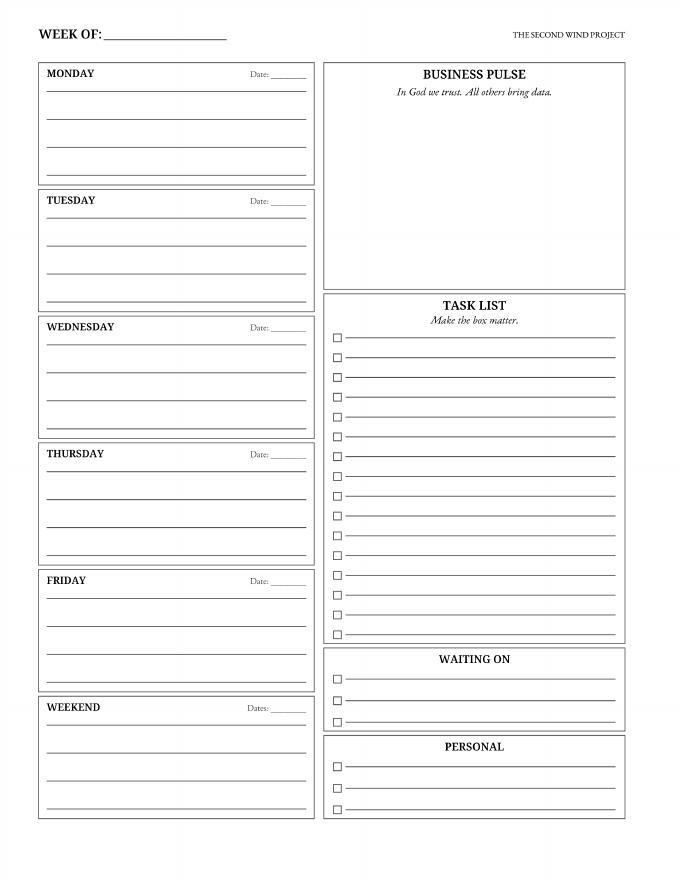
The starting point is a finished, print-ready planner prototype that brings work, personal priorities, task management, notes, reflection, and creative prompts into one practical weekly rhythm. The 132-page interior was designed for a physical Wire-O book and prepared as a production master.
The larger business idea is still prospective: an LLM-guided experience that learns what matters to an individual—their responsibilities, goals, season of life, working style, and preferred prompts—and turns those inputs into a one-of-a-kind planner. Rather than asking people to adapt themselves to a generic template, the product would build the template around the person.
This is presented as a venture concept, not a launched software product. The current proof is the planner itself; the opportunity is to connect discovery, personalization, generation, print production, and replenishment into a repeatable product and business model.
Prototype status132-page print-ready interior
Future concept: an individually generated planner powered by an LLM-guided discovery process
Local go-to-market strategy · 2025
Dalton, Georgia
This 52-slide working plan begins with performance, then examines the market, customer profile, local competition, pricing, assortment, culturally relevant merchandising, marketing, and execution. It shows the complete go-to-market process: understand the audience, define the value proposition, coordinate the offer, and give the field a practical plan.
The work is presented as a proposed go-to-market strategy. Demographic estimates, competitive observations, recommendations, and modeled opportunities retain that status; they are not described here as completed results.
Strategy lensOne store, understood as a complete market
Performance, customer, competition, assortment, pricing, marketing, and execution
Digital growth strategy · March 2026
Building a 10% of sales digital channel
This 54-slide long-range plan examines how digital price visibility affects value perception and how e-commerce can support both online and in-store sales. It develops a staged product and go-to-market roadmap spanning marketplace centralization, API-based pricing, a white-label channel, click-and-collect, retail media, price parity, personalization, and future digital services.
The deck also sets out Product, Sales, Marketing, and operating roles; cost assumptions; adoption forecasts; working-capital mechanics; investment requirements; modeled returns; and potential risks. Figures tied to future participation, growth, liquidity, margin, and ROI are planning assumptions or projections unless the slides identify them as historical performance.
Planning horizonA staged path toward a 10% digital channel
Marketplace foundation, owned-channel economics, price parity, and longer-term buildouts
Enterprise turnaround analysis · April 2025
Sales Recapture
Sales Recapture moved outside the traditional boundaries of a sales plan. It diagnosed the gap between retail performance and wholesale purchases, then examined customer count, core assortment, promotional economics, digital advertising, systems changes, retailer participation, outside purchasing, pricing investment, and category performance.
The result was a cross-company turnaround agenda built from commercial analysis. It distinguished documented performance from modeled opportunities and showed how sales, merchandising, pricing, marketing, technology, supply chain, and retailer economics had to work together.
ScopeOne commercial problem, examined across the enterprise
The commercial pattern
Start with the market.
Customer needs, competitive choices, and account economics define the opportunity.
Design the go-to-market system.
Product, Sales, Marketing, pricing, operating capacity, and investment move together.
Forecast with integrity.
Historical results, projections, and modeled opportunities serve different purposes.
Sources reviewed: the production-ready Second Wind planner prototype, the Dalton, Georgia local go-to-market plan, the March 2026 Building a 10% of Sales Digital Channel long-range plan, and the April 2025 Sales Recapture presentation. The personalized LLM planner is a prospective venture concept, not a launched software product. Historical figures, projections, assumptions, proposals, demographic estimates, and modeled opportunities retain the status given in their source documents; the portfolio does not recast projected outcomes as completed results.